A body of work exploring the nature of communication and information in the age of digital media, with reference to the relationship between text and image and Medium Theory.
Final submission for: MA Creative Practice (Leeds Arts University 2019)
Chair
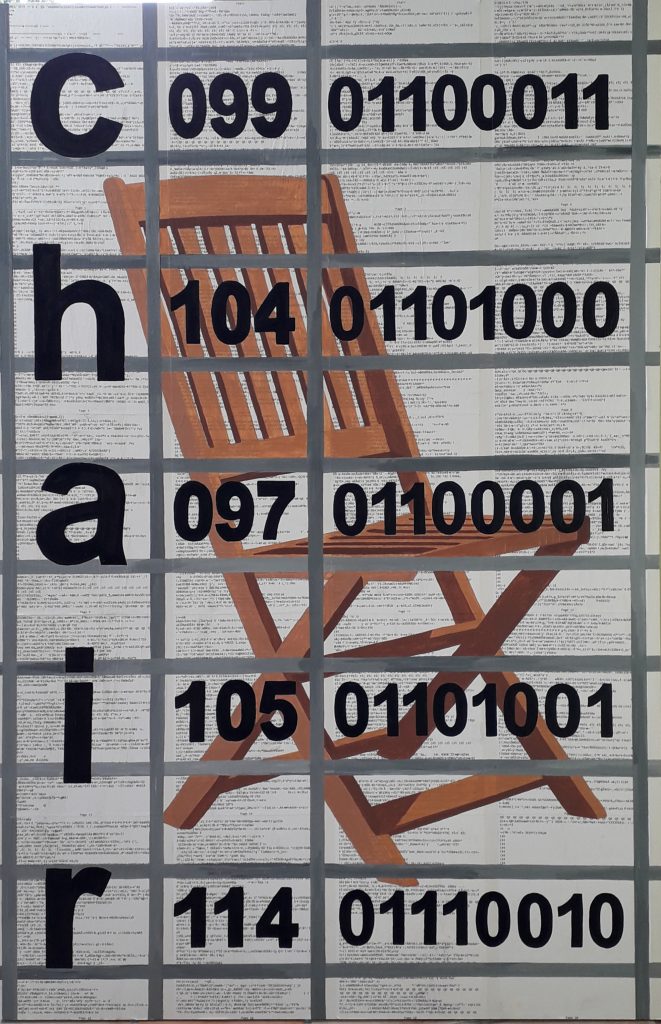
This is a reference to Joseph Kosuth’s 1965 conceptual installation, One and Three Chairs. This consists of a ‘real’ wooden folding chair; a photograph of the same chair; and an enlarged printed out dictionary definition of the word ‘chair’: an object, an image and some text. It shows how visual and verbal signs relate to objects in the real world. It suggests that in terms of meaning, words hold a very loose, non-specific connection with their referents, unlike an image. Jacques Derrida speaks of the “freeplay” of signifiers: arguing that they are not fixed to their signifieds but point beyond themselves to other signifiers in an “indefinite referral of signifier to signified.”
My aim is to represent the layers of reference in the modern production of photographs and text on a computer. The background consists of the file data viewed through the text editor, notepad++, for a jpeg image of a chair, found on a website page on line. In order for the computer to process this, this language is in turn translated or converted into machine code or binary by a compiler. The forefront is the ASCII code for each individual letter of the word ‘chair’; these too have to be compiled in binary for the computer to process it. It is significant that these two sign systems, images and text, which have been separated for centuries by their modes of production, are now reunited in the same basic medium. Pixels and characters are the same in the language of computer code.
In terms of semiotics, it would appear that the sign is even further ‘removed’ from a direct correlation with the ‘original’ object; but this is not the case. The layers of code used in computation are in direct relation as they progress upwards through the chains of commands to produce the sign; the signifiers simply ‘flicker’ rather than ‘float’. The crisis of meaning, if there is one, remains the same.
With reference to: How We Became Posthuman: Virtual Bodies in Cybernetics, Literature, and Informatics by N Katherine Hayles (London: Uni of Chicago Press, 1999)
Pages
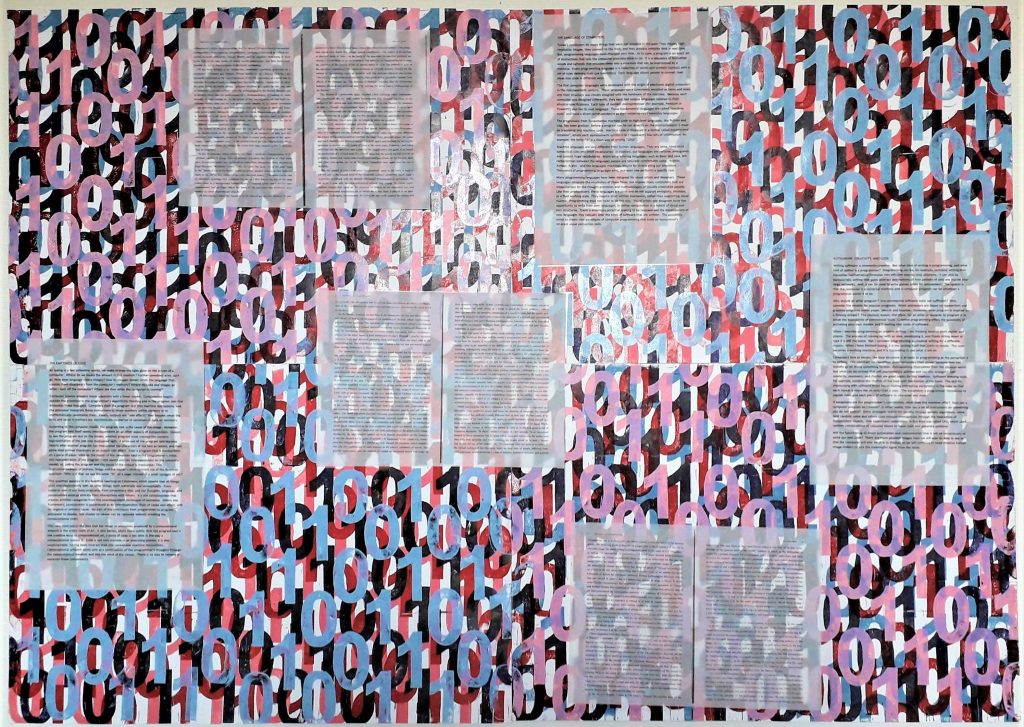
This work is about the magnitude of the electronic operation involved in the formation of a piece of text on a computer in contrast to the visible and comprehensible process of typed text on a sheet of paper and printed text in a book. It attempts to represent the multitude of binary switches in the processor which underlie each symbol and each instruction the computer receives. It is about the unimaginable speed and complexity of these operations and the dizzying patterns of symbolic programming that intervene between this basic machine code and the printed text that results. This ultimately results in the endless capacity for text manipulation, such as insertion, copy and pasting, erasure, etc. All we see are rows of text on a screen, and then the finished article printed out on paper for use.
It also alludes to the fact that the creators of text software use the recognisable interface of a ‘page’ in a book to present text with titles, margins, paragraphs and a linear arrangement of words. The book is a format people feel familiar and comfortable with, even reverential; but the underlying layers of code could be reprogrammed to format text in any conceivable display pattern and in the future probably will.
There are references in several aspects of the work. The background consists of a collage of monoprints produced using a linocut stencil; a reference to the method employed to create text in the age of the printed book. It refers to the fact that 1s and 0s are only a representation of the binary on/off switches of electric current that operate a computer. But in the multi-layered arrangement, there is no perspective; they are all the same size. The rows and columns line up but the colour combinations exist in a different order in each print, which produces the mesmerizing effect. This is an allusion to the fact that in processing, the data remains the same individual units and it is the algorithm applied to it that changes the context.
In addition, the super-imposed text is on tracing paper attached to the collage using sheets of acetate that ‘cling’ to the prints using ‘static electricity’ and for any length of time, magnets placed over drawing pins at the back. This is a reference to the electro-magnetic process that underpins any computer system and the production, storage and distribution of printed material. The transparency of the paper reflects the ethereal quality of the text as it appears as light particles on the screen.
The text is taken from contributory articles in Creative Code by John Maeda (Thames & Hudson, 2004) and from the introduction to Narrative as Virtual Reality 2 by Marie-Laure Ryan (John Hopkins University Press, 2015).
Motherboard
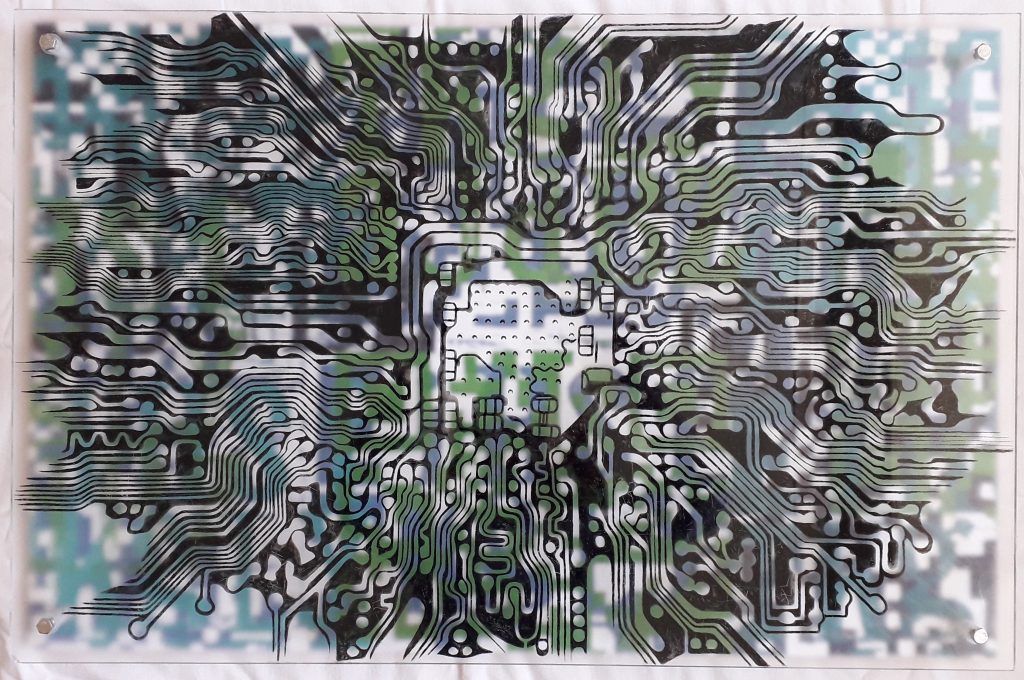
This work is about the transformation of text from simple mark-making to highly intricate and complex electronic functioning and the aesthetic quality of the physical materials and components that enact this operation.
It represents a tiny fragment (6cm x 4cm) of the main circuit board in a computer that produces, stores and transmits data using electric circuits. Electric currents ‘flow’ through channels from point to point in a network of tiny lines and dots, etched and soldered in metal strips and patches. Circuit boards resemble landscapes: Urban cityscapes with edifices and habitats clustered together in drums and towers, connected with main route roads and small side roads; or rural geographies with the natural contours of mountains, fields and forests entwined with paths and waterways. Represented here, the pattern is simplified and reduced to a more organic and fluid arrangement of the system to accentuate its likeness to a maze or map.
The circuit board outline is supported in the background by a collage print comprising fragments of textual forms: alphanumeric characters and QR codes, previously produced by different methods but now assimilated under the same procedural roof. It alludes to a process which is just as incomprehensible as the production of medieval text would have seemed to vast numbers of people in the medieval era. But also to the resulting edifice, which like a medieval cathedral, is the culmination of human scientific and engineering achievement.
The process involved in creating this work required some technical assembly of parts which seems apt considering the subject nature of electronics and technology. My aim has been to capture the transparency of the medium and the way screens aspire to create a perfect illusion or copy of reality. The screen attempts to erase all traces of mediation between the visible text or image and the invisible physical components that engender it. Here, the interface is reversed in that the motherboard image is etched on to (the back of) the screen whereas the text or information code that normally resides before your eyes, lies half concealed beneath it.
It also accentuates the fact that harsh scientific regularity and precision are often derived from and entwined with the activities and qualities of creativity, such as etching and repeat pattern. Artistic practise comprises and combines with scientific innovation to produce something almost magical.
The Ghost in the Machine
“I have just followed the football results and my team has won!” 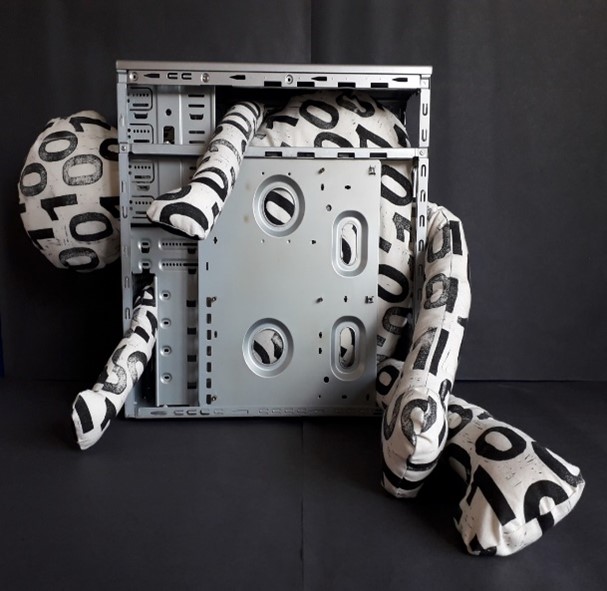
“I have been hooked on a computer game for nine hours!” 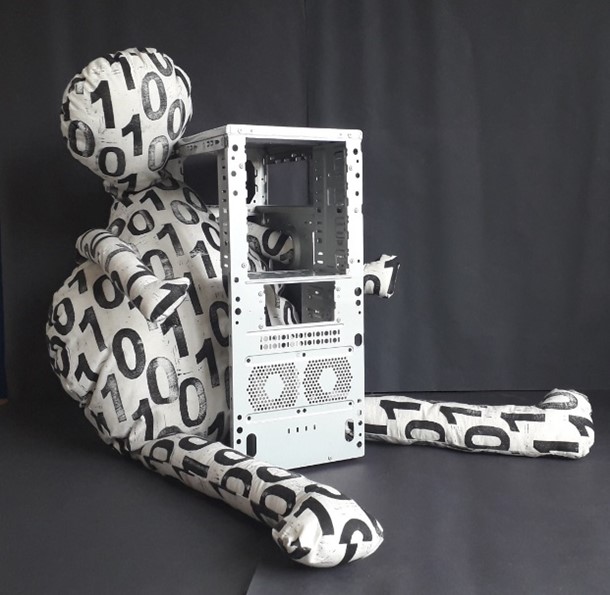
“I have just booked a holiday for two weeks in the sun!” 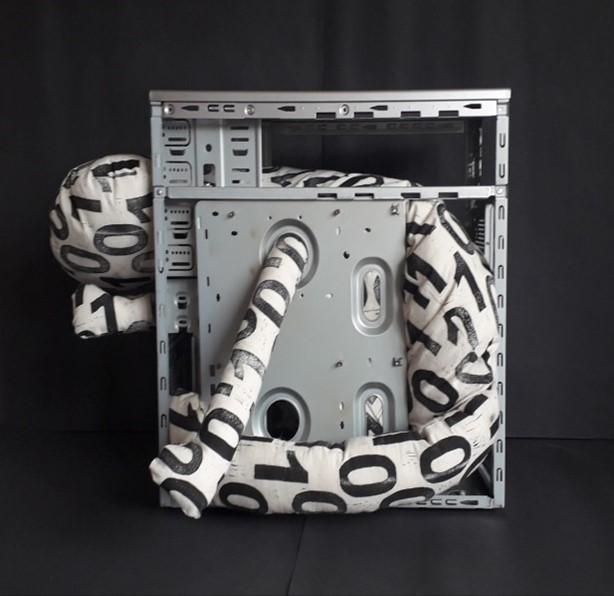
“I have just lost thousands of pounds gambling at poker online!”
A Day in the Life of a Digital Self
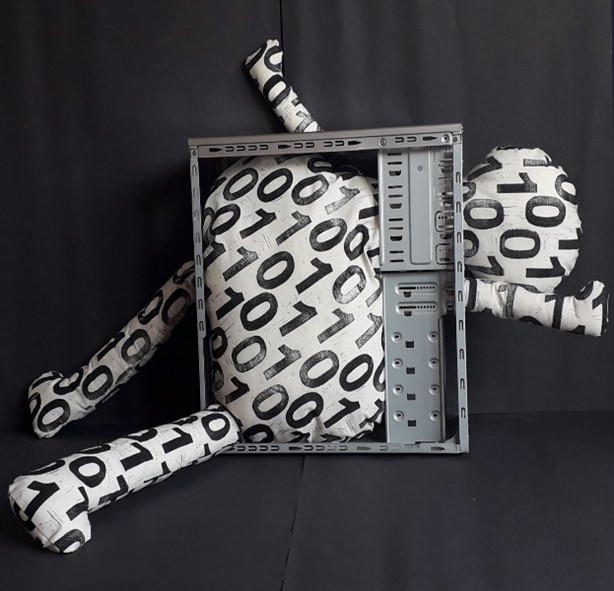
This work is intended to be a collection of 12 photographs of the doll in different positions in and outside a computer tower, with captions to highlight the many occupations and activities that now take place using this piece of technology and the range of emotions we experience as we engage. Other options are: e-mailing relatives, job applications, suicide chatrooms, pornography, social media like Facebook, streaming films and TV, internet shopping and googling information ad many, many, more. It has become a ubiquitous piece of machinery encompassing business, entertainment, communication and self-regulation. We are powerless to function without it.
This work challenges the idea that information can be separated and exist independently from the medium in which it is delivered, such as a book or a computer screen. Information Theories, concerned with technological innovation and progress, have abstracted information into ‘data’ or ‘bits’ that appear to flow from one medium to another in a disembodied state, similar to the ‘ghost in the machine.’ (Cartesian dualism)
Information must have a material base; it must exist in the world and it must be subject to factual tests of truth and falsehood, at least in theory. In the same way, the Self is rooted in a physical body, however far we lend our consciousness to and immerse ourselves in the intricacies of a virtual world. We read a book, we watch a film or we access a webpage. We may switch identity as we travel but we ultimately return to the fundamental world that acknowledges our difference.
The doll in this piece is deliberately ‘faceless’, in the same way as we can interact on line; without gender, age or race. It highlights the fact that in the virtual world, we can be anonymous and ‘free’. The ‘softness’ of the medium reflects the juxtaposition of the natural world and the body with the ‘hard’ metallic world of computer technology. It emphasises the vulnerability of the body and its ability to ‘feel’. There are all sorts of dualistic hierarchies going on here that weave in and out of our unconscious awareness. These oppositions of mind and body, thinking and emotion, gendered bodies and racial bodies are all addressed with a hybrid figure in a surreal environment.
This would suggest we have a dual personality: a real self and a virtual self. But these are simply different manifestations of the same self, which fragments into many different roles and states as we live day to day and interact with others and the wider society in which we live. For example, we have a dream self, a younger self, the self we project in company and the self which others perceive. A digital self is just a further manifestation of this extension; a manifestation that becomes more enhanced and immersed as our sense of self is interwoven with technology.
The photographs were presented in several formats, as is most information in digital culture:
- A poster with 12 images with captions
- A book printed on paper, with one photo and one caption on each page.
- A film with successive clips showing photographs and the captions, arranged in the style of an old black and white movie.
The purpose of these different formats is to demonstrate that, not only are countless activities and functions carried out in a digital format on a computer, many types of medium have also been subsumed by computer technology.
Books, not only exist in electronic format, but ‘real’ books made of paper and ink are formatted and produced using a computer to operate other machinery. A giant network of electronic equipment has replaced the traditional printing press.
Films, too, are not only viewed using electronic devices, such as TV, tablets and phones, their originating elements captured by photographic equipment or cameras are compiled and edited using this technology. Film clips, animated sequences, text and sound are all assembled by software from different sources with a multitude of special effects.
These examples are designed to show this universality, not just in terms of the information being shared, but the different types of medium themselves. It is also significant that in the midst of all this technology, the original object has disappeared. The doll in the computer tower is not required.