Western thought has been dominated by the notion of hierarchy. It is embedded in all the representative mechanisms of our culture, in all our forms of information and all our symbolic means of communication. If reality is determined by the practices of representation and the grammatical structures of our language then reality is awash with hierarchical structures; structures, which we assume are part of the real fabric of things. However, it is this view which feeds ideologies of inequality and requires challenge.
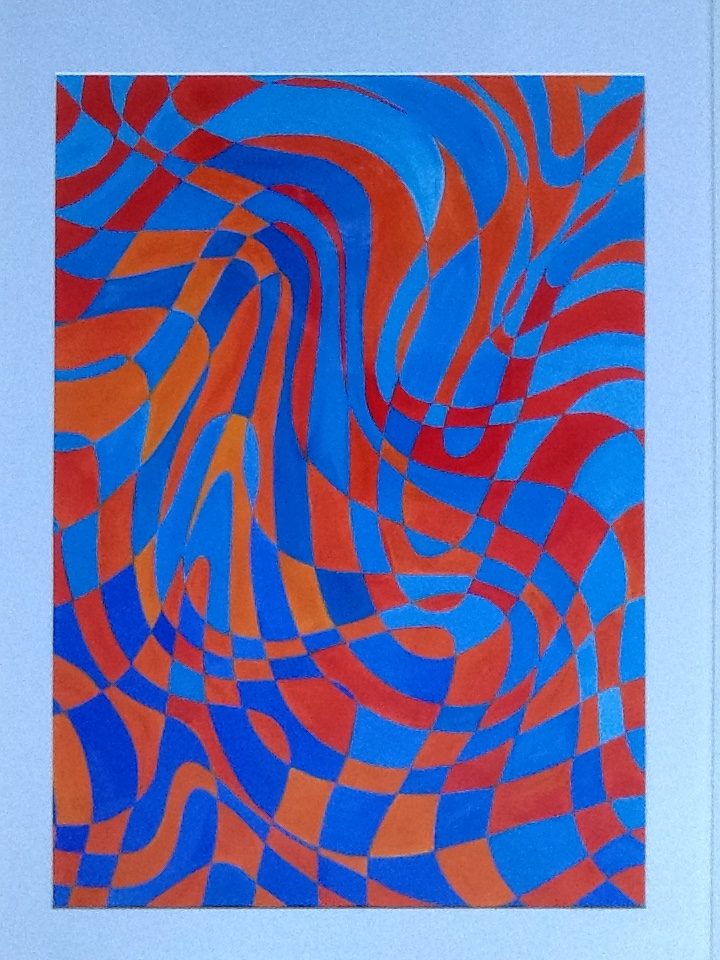
In order to explore how hierarchies prevail, the mechanisms underlying our methods of representation and the structures of language must be examined. The basic elements at the heart of this are grids, lines, text, images and more recently code. How do these elements exact such a powerful influence and project onto our skin and effect our lives? How can we break them down and break free?
This examination has at its core a belief that text and image, once at war, are now more united than ever before and as their properties converge, we must research and test each through words and pictures to recognise the power structures beneath.
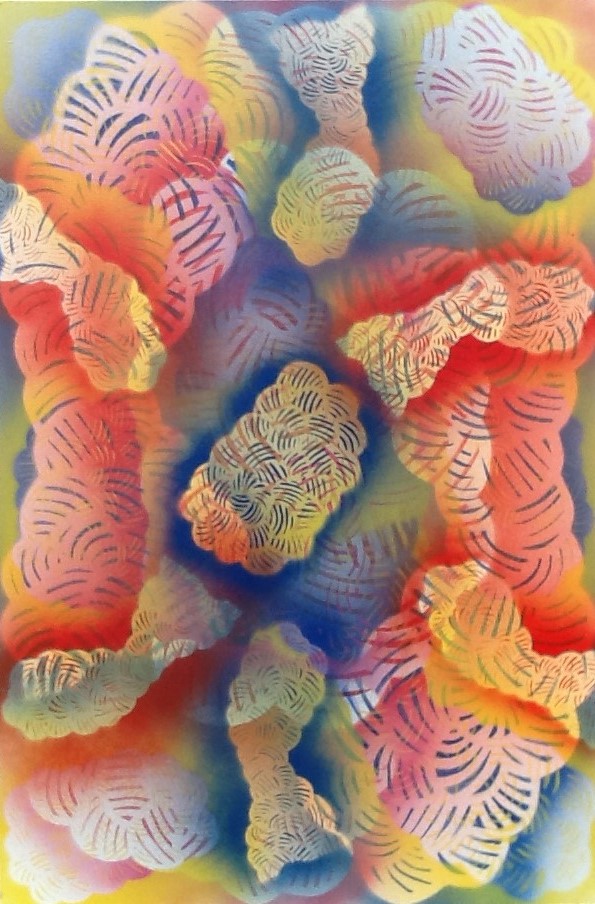
My own practice focuses on the potential disintegration of hierarchies. I use pattern and collage and a multi-media approach. Pattern represents the relationship between lines, shapes and colours and the contingent or complimentary harmony and equality that can exist between them. It highlights the dependence of different elements on each other to exist at all. The dichotomy between abstract and figurative is played out as I experiment with images of the body and motifs to symbolise its raw primal beauty and its lost affinity to the biological world. I see the disruption or the mutation of the pattern as a way to symbolise deconstruction and change. The process of painting and screen printing is a way of trying to capture the unconscious feeling of the mental and the physical as two aspects of the same rather than one being superior to the other. My aim is to challenge hierarchies and create images or objects that represent compatibility and unity instead.
Difference is natural; hierarchies are cultural.
Perception, if we could recall the earliest form of infancy, is pure. We see contrasts in objects, in regard to colour and shape; hear different sounds; taste different flavours. We learn to use words to denote these contrasts, this diversity; to label things with a reference sound and later a complementary image on a page. This denotation encapsulates the difference between objects and qualities like milk and juice, red and blue, hot and cold. They later become besmirched by connotation, metaphorical musings which become associated to a word as they are used in different contexts. This is the level of value, of like or dislike, good or bad. So while difference can be argued to be a natural recognition of the state of affairs that surrounds us, this relation is never neutral. Connotation warps the natural significance of a sign; it clouds it in the cloak of all the unconscious cultural associations which gather round it like an aura. It involves the elevation of one term above another; an acknowledgement of more than or less than an ideal; and a better or worse than something else. But this is a feature of communication, not a perception of a real state of affairs; an outcome of a desire to share our perceptions and discuss them. These relative values are inherent in our language of speech and text and other forms of visual representation, like paintings, photographs, film or television. So our various means of communication encapsulate the framework which structures all our perceptions.
Differentials exist in nature and we perceive them; they are translated into speech or text with words whose purpose is to single out, to capture their impression. We describe the difference with a ‘sounds like’ and this metaphorical description sets the connotation, an attachment with no basis in realty but focused squarely on our emotional response to things. The origins of language are therefore not rational, but imaginative. Look at the way we single out literal language as autistic and abnormal. This contrasts with the origins of an image, which are largely mimesis, a copying, a more direct relation to reality than the word. And yet text, the written equivalent of verbal expression, has acquired a reputation in philosophy and literature far above the status of a mere picture.
Difference is denotation; hierarchy exists at the connotation level of communication; it is not a simple question of perceiving a contrast but of attaching some sort of value to the difference. And then in a metaphorical leap, attaching this same value to other things which need description but have no expression. Black and white are simply opposite poles on a spectrum of colour but it is when they are used to differentiate and describe, for example night and day they acquire a denotation: the dark of night, the light of day. Connotation is acquired when they are used to symbolise the good and evil dimensions of religion and subsequently a person’s moral character, an analogy which extends to the colour of the skin. Similarly, metaphors of space like high and low are ascribed to actions and qualities and become the scale on which we rate all kinds of spatially independent notions like esteem, regard, even cultural pursuits or status in society. Words are like clothes, stretched into all sorts of irregular shapes through wear and tear; clinging loosely to the body that inhabits them.
Science studies variations in our perception of nature but it can only describe its conclusions in language. In an image you can show a range of colour from the darkest shade to the lightest with the infinite number of variations in between. In language we can only describe a few of the variations and only in a relation to a different shade, like light blue or dark blue. Language is always a rough approximation. It also presupposes an original learnt idea of blue. Colour may exist independently of language but it can only be expressed in relation to other colours in language. The nearest we can get to a scale or spectrum of colour is to use numerals, hence the use of mathematics for scientific experiment into variation. Numbers are not definite objects in themselves; they only exist in relation to objects or other numbers. We cannot imagine 2 without imagining 2 things or a sequence of one, two, three. However, an image of three apples, however, shows three apples, no more or less. A specific number of apples and a specific type of apple. Images fit closely to the contours of a body; but they can also shroud them in myth. We often don’t know what an image is communicating to us so we invent our own meaning or need text to ‘pin it down’.
The word ‘London’ refers to a place and evokes transportation, even though we have never been there. We all have a different mental impression, from the minimal form built into the cognitive mechanisms of the mind of a stranger from the stronger, richer experience of an inhabitant, who knows it well. However, a picture of the cityscape with a couple of landmarks, like Big Ben or Buckingham Palace, refers to a specific element of all the connotations that lurk around the sign and make it recognisable.
If we all have a different association as a reaction to the word ‘London’, then all our interpretations are personal, individual and relative. The notion that we address the world through the capacity of reason and that there must be one overriding correct interpretation of all things, based on fundamental principles, is no longer plausible. The idea of a world view enjoying a special status is hegemonism or logocentrism; a hierarchy based on power relations. The world of my experience is relative in terms of the point of view in which I am immersed; an individual image of reality rather than reality itself. Reality is rooted in mental images or ideas as an act of imagination, framed and structured by language; not in an act of rational and dispassionate judgement. Therefore, all points of view are equally valid.
Language, therefore, reflects all historical views in its portrayal of the present by retaining the cultural ideas of the past in its terms and expressions. This forms the basis of our unconscious associations or imagination and the structure in which we think. Metaphorical allusions determined by how people saw the world hundreds of years ago, the distinctions they made, the similarities they observed are all trapped in the images and expressions used to describe present circumstances. The denotations may change but the connotations remain the same. We have to deconstruct these and assign new terms to expect any real significant change. Language is the key.